Learning from Buddha is a supreme Dharma treasure. It will be difficult to attain accomplishment without learning this Dharma.
The English translation of this holy book is now available. Please download the PDF file (Please note: the PDF file was last updated on September 24, 2020) of the English version by pressing either one of the download buttons below.
The following is the book’s table of contents.
Table of Contents Explanation by the Publisher Explanation by United International World Buddhism Association Headquarters Translation Notes 1. Learning from Buddha (Part 1 of 3, Lesson 1) – If You Learn Dharma but Do Not Cultivate Yourself, You Cannot Attain Accomplishment 2. Learning from Buddha (Part 2 of 3, Lesson 2) – If You Cultivate Yourself but Do Not Learn Dharma, You Cannot Generate Realization Powers 3. Learning from Buddha (Part 3 of 3, Lesson 3) — If You Do Not Put into Practice the Lessons You Have Heard on Cultivation and Dharma, It Will Be Like Trying to Scoop up the Reflection of the Moon on Water
When IAMA was first founded, His Holiness Dorje Chang Buddha III loaned the museum about 100 of his artworks. His Holiness Dorje Chang Buddha III has been recognized with numerous awards over the years, such as the Presidential Gold Award, the Dr. Martin Luther King Legacy Award for International Service and Leadership, Fellowship by the Royal Academy of Arts in 2004, and the World Peace Prize at the US Capitol in 2011.
On February 10th, 2004, at the office of British Council in Washington D.C., the Royal Academy of Arts awarded Fellowship to H.H. Dorje Chang Buddha III. His Holiness was the first to be conferred the title of Fellow by that Academy in more than two hundred years.
The artworks of H.H. Dorje Chang Buddha III on display at International Art Museum of America (IAMA) include oil paintings, ink paintings, calligraphy, and sculptures. IAMA’s Treasure Room contains four Yun sculptures by H.H. Dorje Chang Buddha III. His Holiness coined the term Yun Sculpture to reflect the natural harmony and charm that these sculptures embody. On July 28th, 2003, in Washington D.C., the Congress of the United States and the Organization of American States held a Yun Sculpture Exhibition in the Rayburn building at the Capitol. Those sculptures were praised by attending Congresspersons and dignitaries as being a great contribution to mankind, miraculously surpassing the beauty of natural creations, reflecting the highest and most refined level of art possible, and treasures from heaven.
His Holiness Dorje Chang Buddha III also has developed sixteen unique and innovative styles of painting, which are described as below.
CHAOSHI (超實派)
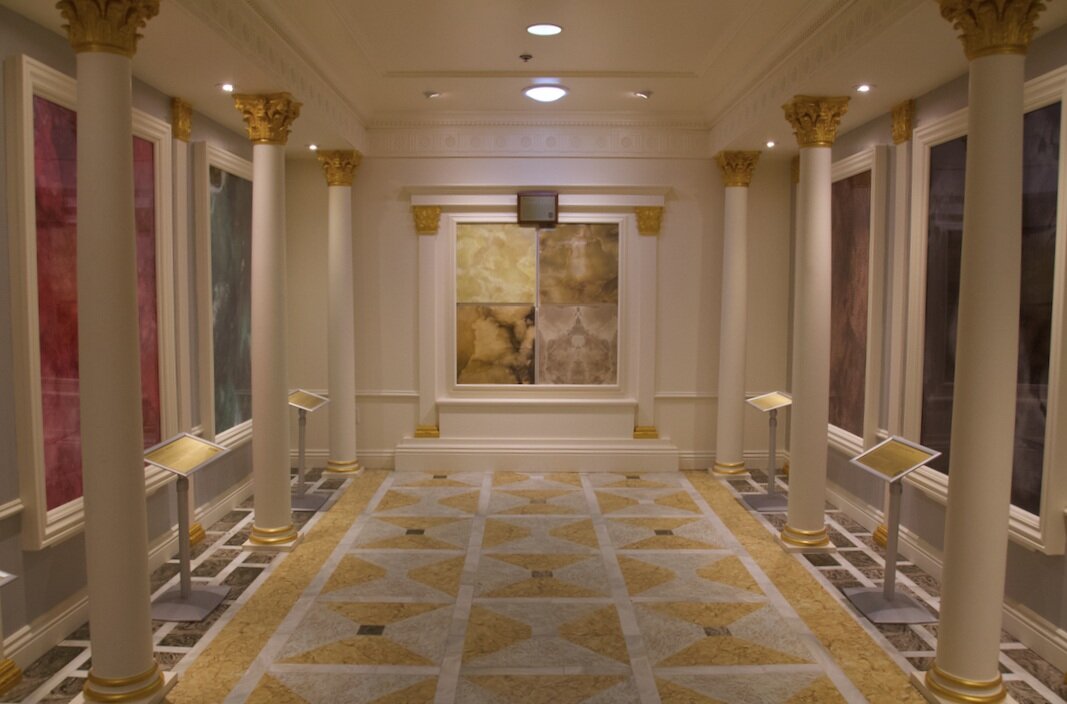
Such paintings are even more lifelike, appealing, detailed, and beautiful than the actual subjects they portray.
Painting Tiles (彩繪磁磗)
CHOUXIANG YUNWEI (抽象韻味派)
The true appearance of the subject portrayed is changed in these captivating ink-wash paintings, resulting in an unconventional image that both looks like yet does not look like the actual subject.
Native Land (故土)
WENFENG (文風派)
Brushwork skills suggestive of scholarliness and poetic charm embody these paintings.
True Source of Calligraphy and Painting (書畫真源)
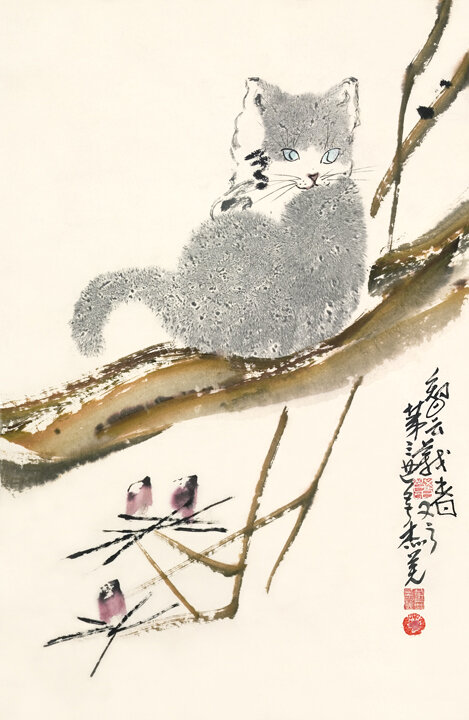
FANGFA (放發派)
This delightful painting style is lively yet natural, producing a dynamic and fascinating effect from scattered ink.
Cat of Unique Charm (靈猫)
MENLONG (朦朧派)
Realism and non-realism are combined to capture the image of the subject portrayed, resulting in a seeming likeness but actual non-likeness of the subject. Brush strokes and color application produce a strong fanciful look to these paintings, a lovely, hazy look in which the real and the surreal mingle.
Wintry Branches in the North (北上冬枝)
YOUSI (游絲派)
Mostly applied in figure painting, this technique uses gossamer-like fine lines to form the contours of the subject.
Monk Jigong(濟公活佛)
FANJUAN (繁卷派)
Numerous strokes of the brush reveal an air of scholarliness. Although a myriad of brush strokes is applied, there is no sense of disorder; rather, artistic talent based on profound and extensive knowledge is expressed.
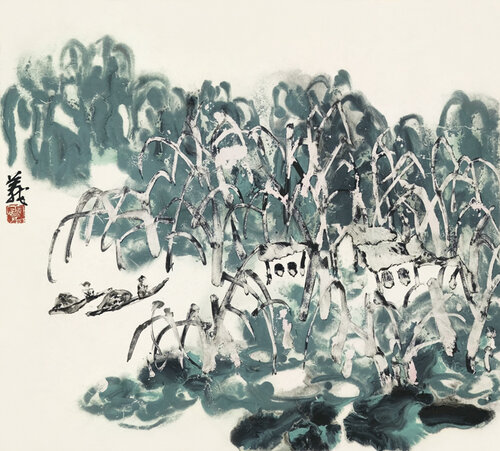
Ferrying the Xia River
POMO XIANTIAO XIEZHEN (潑墨微韻派)
The splash-ink technique is merged with the center brush-tip technique to create realistic paintings of landscapes.
Dragon Pond in Peach Blossom Mountain Village (桃花山莊之龍潭湖)
WEIYIN (微印派)
Theses impressionist paintings have reached such a high level that if any small portion of the full painting were isolated, it would be an exquisite impressionist painting in and of itself. These paintings express a dreamy, illusory state, and any small part of them can be enlarged to form its own beautiful, aesthetically enjoyable painting.
Beyond Craftsmanship (匠心超越)
FANPU (返璞派)
These paintings express the artistic conception of returning to original purity and simplicity. With unfettered hand and mind, the artist applies his most mature skills free of the slightest attachment and with minimal, natural strokes of the brush.
Immaculate (一塵不染)
MAOXIE (妙寫派)
Subtle, fine brushwork and freehand brushwork blend into one. White lines are formed through the delicate, refined, marvelous application of ink rather than the use of white paint. The artist produces the effect of a realistic painting with meticulous attention to detail even though the freehand style is applied.
Viewing the Waterfall Flowing Down Shell Rocks
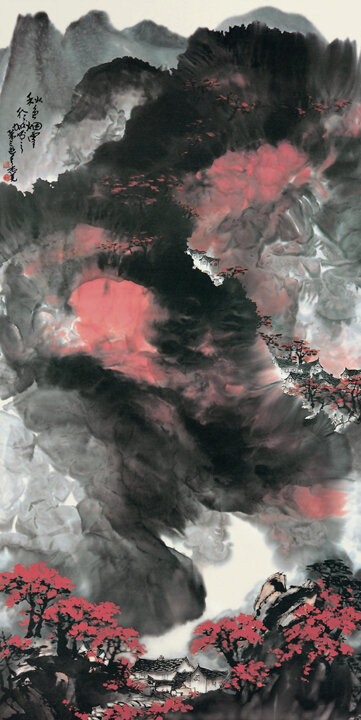
POMO WEIYUN (潑墨微韻派)
Although bold and vigorous hues of watery ink are used, a rich charm is evinced that is both subtle and wonderful.
Mist, Clouds, and Autumnal Color(秋色烟雲)
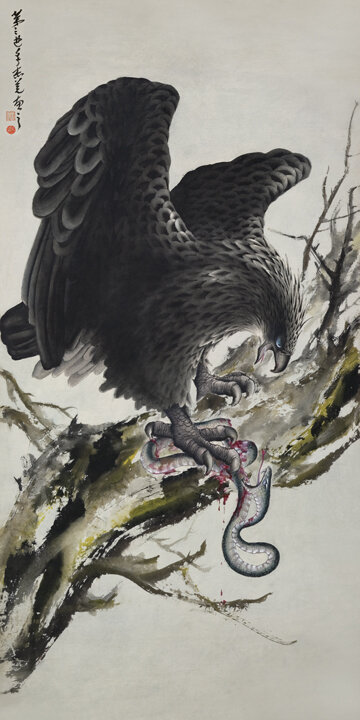
KUANGXI (獷细派)
Such paintings fuse rough and precise artistry. The roughest, most rigid, most vigorous brush strokes of the large-scale freehand style are masterfully combined with the fine, delicate brush strokes of the realistic style, resulting in elegance amid roughness.
The Eagle Vanquishes the Snake(鷹蛇鬥)
XIANGTONG (鄕童派)
There is a rustic and childlike charm to these paintings. With the mindset of an innocent child, the artist casually wields his brush without being led by pre-conceived notions, applying a seasoned adeptness that conveys an impression of simplicity and purity.
Mountain Village with Memories of Mother (憶母山莊)
BANQI (版氣派)
Such paintings appear to be in the style of those imprinted from engraved plates, but they also manifest the flair of the brush. Deep within them is an inexhaustibly enchanting quality that is both natural and lively. They are ink-wash paintings, not paintings imprinted from engraved plates.
I Casually Paint Simply for My Amusement Without any Attachment
THICKLY PILED PATCHES OF COLOR (厚堆色塊派)
Thickly applied oil colors are piled up, giving the painting a three-dimensional look with elegant, vigorous charm. The overall effect is produced through brushwork and a sense of surrealism.
(莫知尊者合掌恭敬而白羌佛提問:First of all, I, Disciple Mozhi, prostrate to my Buddha Master, Namo Your Holiness Dorje Chang Buddha III!
Today, I would like to beseech Buddha Master to impart a Dharma. I know that in the course of imparting Dharmas Buddha Master often revealed unfavorable opinions toward Tibetan Esoteric Buddhism. However, in my poor knowledge, there are many Dharmas within Tibetan Esoteric Buddhism. According to my understanding, the Vajra Dharmas in the Tantric Division are the highest Dharmas. The ten major Vajra Dharmas are the core and key constituents commanding the entirety of Buddha Dharma for attaining accomplishment. Therefore, I beseech my Buddha Master to impart the Dharma that tells us Buddhist disciples: What should we do to be able to learn the best and highest Vajra Dharmas, in order to ensure attaining accomplishment in this current lifetime? Additionally, do these Vajra Dharmas all have rituals and detail procedures or steps of practicing? How should we practice these Dharmas?)
(莫知尊者再度合掌恭敬白羌佛提問:Thank you, Buddha Master. Namo Your Holiness Dorje Chang Buddha III! After hearing the impartations from my Buddha Master, off the many Vajra Dharmas in various sects of Esoteric Buddhism, we are truly astounded and are like being brought to a new world. Then, how can we accurately distinguish and correctly select with a one-hundred-percent certainty among all those Vajra Dharmas, in order to truly achieve great accomplishment and liberation? Also, how do we know the right or wrong of our own Dharma practice? How do we know if we have made progress to develop accomplishment through our practice?)
(莫知尊者合掌恭敬而白羌佛說:I am so grateful to the kindness of Namo Your Holiness Dorje Chang Buddha III! Thank You, my beneficent Buddha Master. Thank you so much for opening the door to the supreme true Buddha Dharma today for us Buddhist disciples. This is actually the Invincible Vajra Dharma! This Dharma is more than sufficient for enabling living beings to become liberated! I am so extremely grateful! I am so grateful!)
(莫知尊者合掌恭敬而白羌佛提問:First of all, I, Disciple Mozhi, prostrate to my !Buddha Master, Namo Your Holiness Dorje Chang Buddha III!
Today, I would like to beseech Buddha Master to impart a Dharma. I know that in the course of imparting Dharmas Buddha Master often revealed unfavorable opinions toward Tibetan Esoteric Buddhism. However, in my poor knowledge, there are many Dharmas within Tibetan Esoteric Buddhism. According to my understanding, the Vajra Dharmas in the Tantric Division are the highest Dharmas. The ten major Vajra Dharmas are the core and key constituents commanding the entirety of Buddha Dharma for attaining accomplishment. Therefore, I beseech my Buddha Master to impart the Dharma that tells us Buddhist disciples: What should we do to be able to learn the best and highest Vajra Dharmas, in order to ensure attaining accomplishment in this current lifetime? Additionally, do these Vajra Dharmas all have rituals and detail procedures or steps of practicing? How should we practice these Dharmas?)
(莫知尊者再度合掌恭敬白羌佛提問:Thank you, Buddha Master. Namo Your Holiness Dorje Chang Buddha III! After hearing the impartations from my Buddha Master, off the many Vajra Dharmas in various sects of Esoteric Buddhism, we are truly astounded and are like being brought to a new world. Then, how can we accurately distinguish and correctly select with a one-hundred-percent certainty among all those Vajra Dharmas, in order to truly achieve great accomplishment and liberation? Also, how do we know the right or wrong of our own Dharma practice? How do we know if we have made progress to develop accomplishment through our practice?)
(莫知尊者合掌恭敬而白羌佛說:I am so grateful to the kindness of Namo Your Holiness Dorje Chang Buddha III! Thank You, my beneficent Buddha Master. Thank you so much for opening the door to the supreme true Buddha Dharma today for us Buddhist disciples. This is actually the Invincible Vajra Dharma! This Dharma is more than sufficient for enabling living beings to become liberated! I am so extremely grateful! I am so grateful!)








 紅色不空索羅馬頭金剛
 (亦名不空羂索馬頭金剛)、黃色不空索羅金剛(亦名不空羂索金剛)、披甲簪芝嘎金剛、白色勝樂金剛、長壽白色勝樂金剛、雙身喜金剛、雙身時輪金剛、大威德金剛十三尊、大威德金剛三十二尊、元聖德金剛勇識六十一尊。另外,品續所說的瓷爐胎藏喜金剛九尊,二品續所說的身藏喜金剛九尊,二品續裡面又說了的意藏喜金剛九尊、語藏喜金剛九尊,杖母乍續所說的身藏喜金剛十七尊、薩母哺乍續所說的語藏喜金剛十七尊,時輪續所說時輪金剛身語意悉圓六百三十四尊,這是非常多的尊頭了。妙喜吉祥六面閻羅敵二十一尊、妙吉祥紅色閻羅敵十三尊、金剛怖畏九尊、怖畏十八尊、水牛頭怖畏九尊,阿密達續所說的勝樂轉輪黑嚕嘎金剛、白勝樂金剛單尊、白勝樂金剛單身二十九尊、藍色雙身勝樂金剛五尊。另外,多啦,各個宗師祂們似乎都有獨自的說法,也就是說,把有些法有改變的,比如說帝洛巴棕白色贖死勝樂九尊、金剛棕藍色勝樂八尊、屍陀林金剛、獅子無畏金剛、單一紅色閻羅金剛、雙身諍論金剛,還有阿底峽所傳的獨雄雙身馬頭金剛、馬頭金翅鳥金剛、四空行圍繞之馬頭金剛、羯磨金剛、四腳不動金剛、八喉不動金剛,迦濕彌羅班欽所傳的金剛是馬頭金剛,吉剛斯所傳的馬頭金剛,祂們之間都有所不同的。
 頂禮 H.H. 第三世多杰羌佛-- 正教