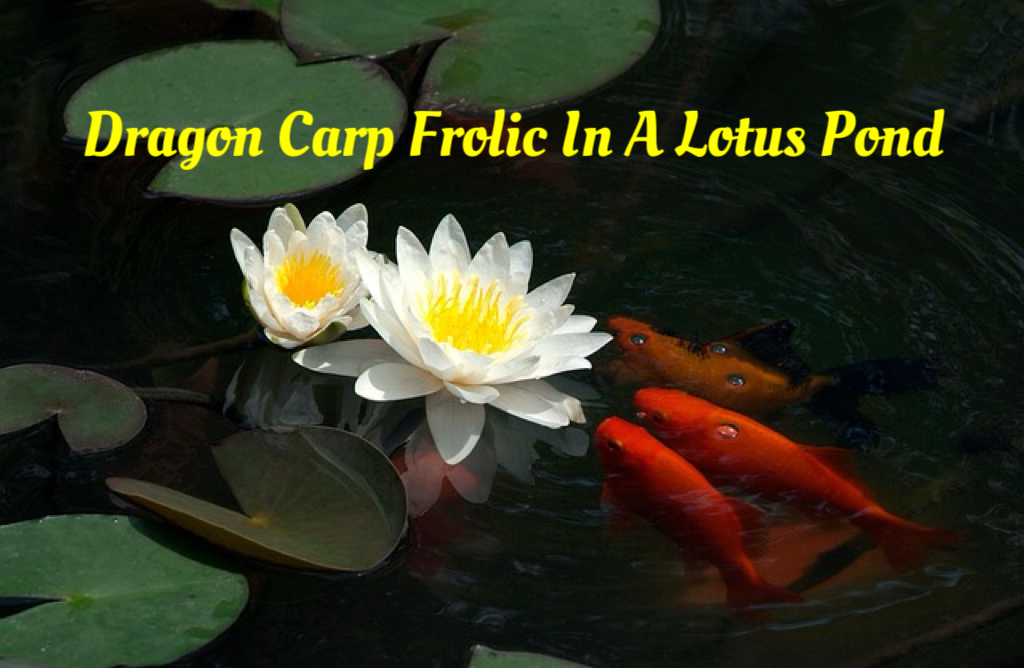
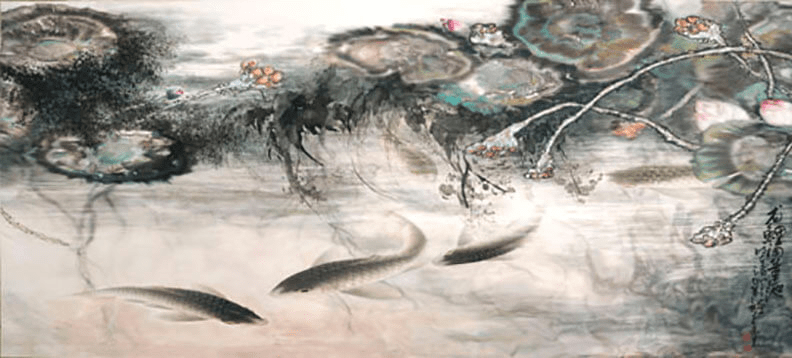
The Dragon Carp Frolic in a Lotus Pond painted by H.H. Dorje Chang Buddha III is appraised as a world treasure of outstanding quality, a peerless and sublime work of art. It is extremely wonderful, for what looks like detailed fine brushwork in it is actually derived from freehand brushwork. Even the small touches can be freehand brushwork depictions of lively charm. All of the six major parts composing this painting – the carp, the lotus leaves, the lotus root, the floating grass, the quality of the water, and the flowers are the fruits of hard work. The painting accomplishes a spellbound and miraculous state that is inimitable. In fact, both the artistic conception of and the prices for paintings by H.H. Dorje Chang Buddha III have reached the topmost level in the world.
This paining is on a permanent exhibition at the Hall Of Fish Paintings By Famous Artists located at 170 E School St., Covina, CA USA. In 2016, someone offered US$60 million to purchase this painting. However, out of concern that once an art collector owns that painting the public will certainly not have any opportunity to appreciate it, H.H. Dorje Chang Buddha III rejected the offer and provided the painting for display permanently.
Seven Types of Holy States Appeared Before One’s Eyes; Based upon Buddha Dharma Realization, Water Was Poured; This Is the True Bathing of the Buddha
June 2, 2004 Reporter Zhuo Ga Dateline: Los Angeles
May 26, 2004 of the Gregorian calendar and April 8th of the lunar calendar was the birthday of Sakyamuni Buddha. The sun over that place in the United States was unusually radiant and beautiful. On a lawn of a religious site surrounded by large blue curtain screens that formed a dignified-looking mandala (Buddhist altar area), great rinpoches, great dharma teachers, and great laypersons from all over the world assembled. An unprecedentedly wonderful “Highest Form of Bathing the Buddha Dharma Assembly” was taking place. This was certainly not an ordinary, worldly bathing of the Buddha accompanied by chanting that one is used to seeing in temples. On such occasions, the participants merely show their respectful hearts. In contrast, the bathing that took place that day was a true bathing of the Buddha grand assembly. At such a Highest Form of Bathing the Buddha Dharma Assembly, the conductor must have the state of realization of a Buddha or Bodhisattva to invoke the manifestation of holy supernatural sights. At the May 26th assembly, the Buddha personally arrived, the dharma protecting Bodhisattvas exhibited holy sights, and celestial dragons and other dharma protecting deities laughed in the sky. It was a grand dharma realm assembly in which various holy scenes unimaginable to worldly people appeared. Buddha Vajradhara Great Dharma King Yisinubu (H.H. Dorje Chang Buddha III), who is the supreme leader of both exoteric and esoteric Buddhism, conducted that assembly and practiced the dharma during that assembly.
The Dharma Assembly was divided into an internal mandala and external mandala. The internal mandala was the central area where the Buddha was bathed. The external mandala was the dharma realm of accomplishment. Eminent monastics and persons of great virtue attended the Dharma Assembly. Those who were part of the internal mandala included Akou Lamo Great Rinpoche, Zhaxi Zhuoma Rinpoche, Dharma Teacher Long Hui, Dharma Teacher Jue Hui, Dage Gongla Rinpoche, Bodi Wentu Rinpoche, Dharma Teacher Kui Zhi, Dharma Teacher Ruo Hui, layman Ciren Gyatso, Dharma Teacher Miao Kong, Dharma Teacher Baolian, and others. Those who were part of the external mandala included Fuzang Wanghu Great Rinpoche, Yan Long Great Rinpoche, Awang Nuobu Great Rinpoche, Kang Qin Great Rinpoche, Xirao Zhibenge Rinpoche, Yixi Kanbu, Dharma Teacher Cikong, Dharma Teacher Fahai, Dharma Teacher Cixin, Dharma Teacher Haoling, and others.
The dharma stipulates that the purpose of a Highest Form of Bathing the Buddha Dharma Assembly is pouring dharma water that has been used to bathe the Buddha. The ability to pour such dharma water is based upon one’s true level of realization. Pouring such water bathes the celestial beings in the various heavenly realms. It shows that the Buddha blessed the celestial beings in the various heavenly realms, the dharma protecting deities, and the seven types of disciples. Thus, there must be a successful “pouring of water based upon one’s true realization.” Otherwise, it is not a Highest Form of Bathing the Buddha Dharma Assembly.
Additionally, at that Dharma Assembly all seven holy states were manifested. The seven types of holy states are: (1) Wind Celebrates the Mandala, (2) Flowers Rain from a Tree, (3) A Dharma Object Manifests Holiness, (4) A Cloud Provides an Umbrella-Like Covering, (5) Celestial Dragons Laugh Joyfully, (6) A Rinpoche is Given a Sign, and (7) The Color of Dharma Water is Received.
The successful “pouring of water based upon one’s true realization” is the most important part of such a Dharma Assembly. It is the key aspect of a Highest Form of Bathing the Buddha Dharma Assembly. It is why the name of such a Dharma Assembly contains the words “Highest Form.” Three to five thousand pounds of dharma water are used to bathe the Buddha. After the Buddha is bathed, this water is used to bathe the celestial beings in the various heavenly realms. When bathing the celestial beings, the dharma water must be poured down from the lotus tub used to bathe the Buddha into the tub used to bathe the celestial beings. During the pouring process, one cannot touch the dharma water with any part of one’s body, nor can one use any type of container to be filled with water. That is because the human body and containers are soiled by unclean dust and dirt. People are only allowed to tilt the entire lotus tub used to bathe the Buddha so that water is poured downward.
With such a heavy amount of dharma water in the lotus tub used to bathe the Buddha, how could anyone tilt that tub to pour the water down into the tub used to bathe the celestial beings? One must rely upon one’s Buddha-dharma state of realization. But no more than ten people can attempt to lift the lotus tub used to bathe the Buddha. Otherwise, it would not be regarded as the Highest Form of Bathing the Buddha Dharma Assembly. If the dharma water is not successfully poured into the tub used to bathe the celestial beings, then no matter what types of supernatural holy sights may appear at the Dharma Assembly, it cannot be called a “Highest Form of Bathing the Buddha Dharma Assembly.”
FLOWERS RAIN FROM A TREE
The seven kinds of disciples pour ninety buckets of fragrant water into the lotus tub used to bathe the Buddha.
The atmosphere that day at the mandala to bathe the Buddha was holy and solemn. Great Dharma King Yisinubu wore his Dharma King robe. He had an extremely dignified-looking appearance. A golden bronze statue of Dharma Prince Siddhartha stood in the mandala. In the middle of the mandala was a lotus tub used to bathe the Buddha that was 3 feet high, square, and weighed 700 pounds itself without water. Over the middle of that tub was a beautiful lotus flower about the size of a car wheel. Below and adjoining that lotus tub used to bathe the Buddha was a rectangular, one-foot high tub used to bathe the celestial beings. Ninety buckets of fragrant water were also placed in the mandala to be used to bathe the Buddha. The offering water in those buckets was light brown due to the sandalwood, eaglewood, saffron, and other scents that were boiled and added to the water.
At the beginning of the Dharma Assembly, the Great Dharma King practiced Dharma according to Buddhist scriptures. As soon as the Great Dharma King began practicing Dharma, a tree full of jacarandas (a pale purple flower) immediately began raining flowers. The jacarandas drifted in the golden sunlight and fell all over the mandala and into the ninety buckets of water. Auspicious clouds rolled through the sky. It seemed that the mandala was no longer part of this world. Rather, it seemed like a holy Buddha-land. Flowers rained for more than three hours continuously, starting from the beginning of the Dharma Assembly. Those flowers floated down upon everyone. However, not one petal touched the Great Dharma King. When the Dharma Assembly ended, the flowers instantly stopped raining.
A DHARMA OBJECT MANIFESTS HOLINESS
During the Highest Form of Bathing the Buddha Dharma Assembly, some people saw the Vajra Wheel float up, sink down, and move around in the water. Some also saw the appearance of eight dharma protecting deities. Additionally, some people saw two dharma protecting deities Mahakala and Sri-maha-devi supernaturally change their forms. On the right side of the left picture, the head of a Dharma protecting deity is very small. The deity is wearing a helmet, and its right hand is holding a skull used to subdue demons. Its left hand is holding a bell. In that left picture, the small head of the Dharma protecting deity on the left suddenly became a large head (see right picture). In the left picture, the whole body of the Dharma protecting deity on the right is tightly covered with armor. The sleeves of its red robe are small. In the right picture, the small sleeves of the Dharma protecting deity on the right suddenly spread open. Its red sleeves and robe became large. It used its hand to lift the robe on its left leg, thereby exposing its leg. In an instant, the two dharma protecting Bodhisattvas appeared. In an instant, they disappeared from the Vajra Wheel without a trace. In both pictures, the Vajra Wheel turned into the shape of a lotus leaf floating on the water. From the size of the Vajra Wheel’s shadow, one can know the height of its position in the water. The water was outdoors and reflected countless green lotus flower leaves in the sky.
In order to express the unity of exoteric and esoteric Buddha Dharma, the Great Dharma King did not select a highest-level practitioner of great virtue or a highest-level Great Rinpoche to announce and conduct the rituals and ceremonies of that Dharma Assembly. Rather, the Dharma King selected Great Dharma Teacher Long Hui to announce the rituals and ceremonies. Great Dharma Teacher Long Hui is Han Chinese and is Chairperson of the International Buddhism Sangha Association. The Dharma King also selected Great Dharma Teacher Jue Hui, Great Dharma Teacher Kui Zhi, Great Dharma Teacher Ruo Hui, and Dharma Teacher Miao Kong to conduct the rituals and ceremonies.
When Great Dharma Teacher Long Hui announced that all Buddhist disciples in attendance should pour fragrant water into the tub used to bathe the Buddha, all of the Rinpoches, Dharma Teachers, and laypersons in attendance quickly poured the ninety buckets of light brown fragrant water into the tub used to bathe the Buddha, filling it up completely. Everyone then returned to their seats and respectfully requested that the Great Dharma King consecrate the fragrant water in the lotus tub. The Great Dharma King was then seen holding a white Vajra Wheel. The Great Dharma King approached the lotus tub used to bathe the Buddha and placed that dharma object (i.e. the Vajra Wheel) into the water. That dharma object is half as thick as a coin and as large as the palm of the hand. The Buddha-dharma stipulates that only a Buddha Vajradhara Dharma King may possess such a Vajra Wheel. After the Buddha Vajradhara Dharma King’s empowerment, the dharma protecting Bodhisattvas in the sky descended upon that dharma object. That dharma object can move around in the dharma water used to bathe the Buddha. It can rise up in the water and sink down into the water. After it does this, the practice of the Highest Form of Bathing the Buddha Dharma Assembly may begin.
Everyone surrounded the lotus tub to see that dharma object. One or two minutes later, everyone indeed saw the Vajra Wheel moving in the water. No one touched the lotus tub. While in the water, that dharma object moved forward and backward, to the left and the right, all on its own. One moment, it sank downward; the next moment it floated to the surface of the water. When the Vajra Wheel was approaching the bottom of the water, many saw red light emanate from the bottom of the Vajra Wheel. That red light was the true fire of samadhi. Many people saw eight dharma protecting Bodhisattvas standing on that dharma object. There were also those who saw Mahakala and Sri-maha-devi supernaturally change their forms on that Vajra Wheel. Everyone present was full of dharma joy.
WIND CELEBRATES THE MANDALA
After a dharma object manifested holiness, everyone began to respectfully recite the invocation text. Suddenly, a strong wind began blowing from the west. Trees began to sway and things began to shake in the once peaceful mandala. Jacarandas flew through the air. Everyone was amazed. Indescribable and auspicious dharma joy filled the entire assembly. The world-honored Buddha had arrived in the sky above the mandala to manifest the Dharma! Everyone chanted a mantra in unison to respectfully welcome the arrival of the Buddha. That strong wind from the west blew for a period of time and then abruptly stopped. The quietude of the mandala was restored.
An auspicious atmosphere filled the mandala. Amid the sound of everyone chanting a mantra, the holy ritual of bathing the Buddha formally began. Great Dharma Teacher Kui Zhi respectfully lifted the statue of Dharma Prince Siddhartha off the altar and put it on the lotus flower in the middle of the lotus tub. Everyone then respectfully requested that the Great Dharma King bathe the Buddha. After the Great Dharma King bathed the Buddha and practiced Dharma, each of the attendees bathed the Buddha three times. Great Dharma Teachers Jue Hui and Ruo Hui wiped dry the statue of the Buddha with a white silk scarf, put a robe on the statue of the Buddha, and placed it back on the altar.
POURING OF WATER BASED UPON ONE’S BUDDHA DHARMA REALIZATION
After the Buddha is bathed, according to the rules and rituals of the Buddha-dharma, it is time to pour fragrant water from the lotus tub used to bathe the Buddha into the lower tub used to bathe the celestial beings. At that time, the Great Dharma King must practice Dharma to bathe the celestial beings. According to fixed Dharma, the bathing of celestial beings must take place in order for it to be a real Highest Form of Bathing the Buddha Dharma Assembly. Otherwise, the words “Highest Form” should not be used. This is the key factor in determining whether the Dharma Assembly will be completely successful.
Dharma Teacher Long Hui announced the ritual and requested that everyone attempt to lift the lotus tub used to bathe the Buddha so that its fragrant water would pour into the tub used to bathe the celestial beings. All of the attendees stepped forward one after another and attempted to lift it in groups of ten. However, no matter how hard they tried, they could not lift that lotus tub. Later, in violation of the rules, fourteen strong men together attempted to lift that tub. They assumed various postures and used all of their strength to tilt that lotus tub while shouting out a mantra. In the end, their faces turned red, they became exhausted, and they gave up in frustration. They were not able to move that lotus tub one bit. With awkward smiles on their faces, they went back to their seats.
Fourteen people using all their strength could not lift the lotus tub used to bathe the Buddha that was filled with fragrant water.
Akou Lamo Rinpoche and Ciren Gyatso Rinpoche exhibit their true Buddha-dharma states of realization by lifting 4,260 pounds of holy water used to bathe the Buddha and pouring such water into the tub below used to bathe the celestial beings. What ordinary person in this world could lift such a tub? Only those who learned the true Buddha-dharma can lift it.
That lotus tub used to bathe the Buddha weighs more than seven hundred pounds. When 90 buckets of fragrant water used to bathe the Buddha were added to this weight, the total weight was 4,260 pounds. Only a large crane could lift that tub. Even world-class musclemen would have no chance of lifting it.
Everyone looked at the lotus tub and felt the situation was hopeless. Great Dharma Teacher Long Hui did not know whether to cry or laugh. She could not announce that the ritual was successfully completed. Under these circumstances, the Dharma Teacher thought of a disciple of the Great Dharma King by the name of Akou Lamo Rinpoche. That Rinpoche is from Tibet and can cause a mani stone to fly through the air. Great Dharma Teacher Long Hui asked Akou Lamo Rinpoche to test her strength and attempt to lift the lotus tub. Akou Lamo Rinpoche said, “I want to select someone to assist me.” She then invited an elder layman who lives in the United States, Ciren Gyatso, to step forward and assist her. Elder layman Ciren Gyatso has realized the state of prajna emptiness. He constantly abides in the Dharmakaya state. His state of realization is extraordinary. He is the person of great accomplishment spoken of in the tapes contained in The Silver Box.
Akou Lamo and Ciren Gyatso each held one side of the lotus tub. Upon Akou Lamo’s uttering the mantra “Ong Ah Hong,” they lifted their shoulders. With a roaring sound of cascading water, the lotus tub tilted upward. Holy water used to bathe the Buddha was poured into the tub used to bathe the celestial beings. Upon another uttering of the mantra “Ong Ah Hong,” the two of them again lifted the lotus tub. Like a silver pillar, dharma water poured into the tub used to bathe the celestial beings.
All of the attendees were astonished! They sat there dumbfounded. Fourteen men using all their strength in concert could not move that more than four thousand-pound lotus tub. However, to everyone’s surprise, a young woman and an elder man seventy years old exhibited their states of realization and lifted that lotus tub for all to see! What a wonderful expression of the true Buddha-dharma, of the power of Vajra! Neither of them has any innate spiritual powers. Under Great Dharma King Yisinubu, they have practiced and learned the true Dharma and have reached a high level of Buddha-dharma realization. That is why they were able to successfully complete the key ritual of the Dharma Assembly—pouring water based upon one’s Buddha-dharma realization. All of the attendees were surprised and praised the two of them highly. Everyone was moved and joyful. That Highest Form of Bathing the Buddha Dharma Assembly was successful precisely because of this holy event.
CELESTIAL DRAGONS LAUGH JOYFULLY
After pure water used to bathe the celestial beings was successfully poured, the Great Dharma King began practicing the Dharma to bathe the celestial beings. As soon as all of the attendees chanted in unison one time the verses relating to bathing the celestial beings, suddenly, a strong wind began swirling. The curtain screens began to bulge and rumble. The tankas hanging on the curtain screens flew upward in a ninety-degree angle from the ground. The poles holding up those curtain screens creaked in the wind as if they were about to break. Even the sandbags used to anchor the curtain screens were turned over and moved by the wind. Two-thirds of the people there heard very loud, low, and deep dragon roars explode in the air accompanied by the clap of rolling thunder. One-third of the people there only heard the sound of the wind but did not hear the sound of thunder. This all the more proves the magnificence of the Buddha Dharma, since different karmic states manifested at the same time.
At that time, the hot sun was high in the sky. It seemed as if the joyful roars of the celestial dragons shook the sun so that it shined even more brilliantly! The dharma protecting deities came to the mandala where the Buddha was bathed and received a dharma bathing bestowed by the Buddha! At this time, people remembered that a few days before the Dharma Assembly when the curtain screens and dharma altar were being erected, the Great Dharma King personally arrived. He repeatedly instructed everyone to fasten well the foundational support for the dharma altar and curtain screens so that the altar and screens would not be blown over by the wind. A layperson whose last name is Hsu said to the Dharma King, “The weather station forecasted that there will be no rain or wind for the next seven or eight days.” The Great Dharma King then told everyone, “At the Dharma Assembly, of course it will not rain. However, when I practice the Dharma, a strong wind will blow. There will be strong gusts of wind, especially when all of the dharma protecting deities arrive and manifest their powerful spirits. Therefore, the foundational support must be fastened firmly.” It is very fortunate that the Great Dharma King made such a prediction. On the day of the Dharma Assembly, the dharma protecting deities joyfully laughed in the sky. Although there were strong gusts of wind, the dharma altar and curtain screens did not fall.
A RINPOCHE IS GIVEN A SIGN
After the Dharma King practiced Dharma to bathe the celestial beings and the dharma protecting deities, he instructed everyone to look inside the water to see whether the Vajra Wheel was moving. People were amazed to see that even though those two people with holy virtue and high states of realization lifted the lotus tub and thereby poured dharma water from a tub weighing more then 4,000 pounds downward into the tub used to bathe the celestial beings, the Vajra Wheel surprisingly did not move in the slightest. The Vajra Wheel remained in its original position. Many people saw eight dharma protecting Bodhisattvas standing on that dharma object blowing air upward.
At this time, a Rinpoche who weighs 280 pounds beseeched the Vajra Wheel to manifest its powers and eliminate his remaining karmic hindrances. The Great Dharma King agreed to this request and put the Vajra Wheel on that Rinpoche’s chest. At first, that Rinpoche felt that the temperature of the Vajra Wheel was cool. The Great Dharma King then began intoning a mantra. With his fingers pointing to the sky, the Great Dharma King lightly snapped his fingers. That Rinpoche suddenly let out a miserable scream. He was in such pain his face turned pale. Like the power the Incantation of the Golden Hoop had over the Monkey King in Journey To The West, the Great Dharma King’s mantra caused the solemn face of the Rinpoche to become distorted from pain he could not endure. It seemed that Rinpoche could not endure the pain. As a result of the Great Dharma King practicing a certain Dharma, the Vajra Wheel emitted the true fire of samadhi. Its temperature quickly rose to an extremely high degree. Of course, that Rinpoche could not endure such heat.
The Great Dharma King then snapped his fingers again, and the true fire of samadhi instantly disappeared. The Vajra Wheel suddenly became cold. That Rinpoche immediately returned to his normal condition. He was not injured in the least. However, there remained an imprint of the Vajra Wheel on his chest. The Great Dharma King predicted that after one week a three-dimensional dharma object in relief would grow out of the imprint on that Rinpoche’s chest. That Rinpoche was full of dharma joy and thanked the Great Dharma King for eliminating his karmic hindrances. That Rinpoche then vowed to do his utmost to benefit living beings.
Out of the mark on the body of that overweight Rinpoche, a mandala object has already grown. A ring of light as bright as the light of a flashlight emanates from his skin around that mark. Great Dharma King Yisinubu said, “Next, it will further extend outward, will be translucent and lustrous, and will be like the skin of a baby.”
A CLOUD PROVIDES AN UMBRELLA-LIKE COVERING
From the beginning of the Dharma Assembly all the way to its end, a beautiful cloud continuously floated in the sky above the mandala. The shadow of that cloud continuously covered the bronze statue of Dharma Prince Siddhartha. The Dharma Assembly lasted more than three hours. The sun moved westward. That cloud moved together with the sun. It was like an umbrella that served to block the sunlight from the statue of Dharma Prince Siddhartha. However, the sun continued to shine upon the area of the dharma altar only two or three inches from the statue of Dharma Prince Siddhartha.
Buddhist disciples bathe the Buddha. A colorful and auspicious cloud continuously shaded the statue of the Dharma Prince like an umbrella. For more than three straight hours, it did not let the sun shine on the body of the Buddha.
THE COLOR OF DHARMA WATER IS RECEIVED
The Dharma Assembly ended solemnly. With buckets, everyone took some dharma water from the tub used to bathe the Buddha and the tub used to bathe the celestial beings. Suddenly, someone said in a surprised manner, “The dharma water is changing!” Everyone rushed over to see. They discovered that the ninety buckets of light-brown fragrant dharma water taken from the tub instantly became clear water. The Buddha and the celestial beings received the merit of that fragrant water. The merit of the Dharma Assembly was wonderful and complete. All of the attendees prostrated and uttered words of praise.
Great Dharma King Yisinubu conducted this Highest Form of Bathing the Buddha Dharma Assembly, a respected event in the history of Buddhism. The Great Dharma King practiced the Dharma during this assembly. All seven holy states were manifested. Water was poured based upon the states of realization of those who poured it. Those two people thereby exhibited their extraordinary powers. The Buddhas and Bodhisattvas and the heavenly dharma protecting deities personally arrived at the mandala and received bathing water bestowed by the Buddha. Various holy states of the Buddha-dharma appeared one after the other. Only this type of magnificent Bathing the Buddha Dharma Assembly is a true Bathing the Buddha Dharma Assembly as stipulated in the Dharma. This grand event in Buddhism took place as a result of the good fortune of living beings.
After the Dharma Assembly, one of the two persons with high states of realization who lifted that lotus tub, Akou Lamo Great Rinpoche, requested that the holy lotus tub used to bathe the Buddha be transported to Tibet so that it could serve as an offering in furtherance of Tibetan Buddhism. Great layperson Ciren Gyatso requested that it be kept in the United States as an offering. In order to be fair, the Great Dharma King had everyone vote on the matter. Akou Lamo Great Rinpoche lost the vote by a ratio of three to two. The United International World Buddhism Association Headquarters will keep that lotus tub used to bathe the Buddha. It will be kept in the United States as an offering.
Dharma Teacher Long Hui then announced that all of the attendees should dedicate the merit of that day’s dharma practice to a holy person who had recently passed away, laywoman Wang Cheng E-Fen. This holy person was not a follower of another sect. Dharma Teacher Long Hui said that she was, rather, a relative of our most esteemed Master, the Buddha Vajradhara Great Dharma King. This holy person followed the Great Dharma King and practiced Guan Yin Bodhisattva Dharma. On May 23rd, she passed away in Xindu, Sichuan, China.
On May 29th, a reporter received a fax from Xindu. After this holy, elder laywoman passed away, unprecedented holy states appeared. Everyone saw the appearance of auspicious, multi-colored clouds. Amitabha Buddha, Guan Yin Bodhisattva, and other Buddhas and Bodhisattvas appeared in the sky. A multi-colored Buddha light appeared in the sky and surrounded the earth. The head of that elderly laywoman radiated a Buddha light. She left behind more than 60 extremely wonderful, firm relics. These relics were both round and rhombic. The discovery of such holy phenomena was unprecedented in the history of Baoguang Chan Temple, one of the four great temples in China where that laywoman was cremated.
Furthermore, in the afternoon of February 15th of the lunar calendar in the year 1991, Wang Ling-Ze, who was the husband of Wang Cheng E-Fen, stepped outside his house in the Laodong Village of Xindu County. Standing in front of his house, he urged people to be kind and good. He described to people holy sights in the Western Paradise of Ultimate Bliss and told everyone of the true Buddha-dharma. After giving his Dharma talk, he showed his control over his own birth and death. Right then and there, he sat down in the cross-legged posture and passed away. He sat there serenely for seven days. His face was like that of a living person. He was also cremated at Baoguang Temple. Many holy phenomena appeared during his cremation. After he was cremated, he left behind thirteen firm relics. These two highly virtuous people were very close relatives of the Great Dharma King. They learned under the Great Dharma King, received true Dharma from the Great Dharma King, and ended the cycle of birth and death.
為世界吉祥昌盛盡綿帛之力,為法界增添解脫聖眾而呈此書,我編著此書免除收取一切版權費用,純屬義務盡心之行,若有功德,全數迴向給身處 B 型流感病毒、新冠狀瘟毒等各類瘟疫病難中的世界各地的眾生,祈願受災難者急速消除苦厄,轉為平安!
感恩我師羌佛祈禱消除 B 型流感病毒、發生在武漢的新冠狀肺炎!誠如羌佛恩師在一月三十日的法音中所說:新冠狀病毒雖然嚴重,但很快就會過去。現在,發生在武漢的新冠狀肺炎確實已得到控制,但世界多國近期又突然爆發新冠狀瘟疫,甚是嚴重。聖德們聯合祈請我師羌佛再度加持消除正在全世界蔓延的新冠狀疫病。羌佛說:“我會祈禱,大家放心,但我深感慚愧,諸佛菩薩會加持消除正在世界蔓延的這場瘟疫。現在國家很重視,會有很好的藥物治理這些瘟疫,人們一定會度過疫難,獲得平安的。”
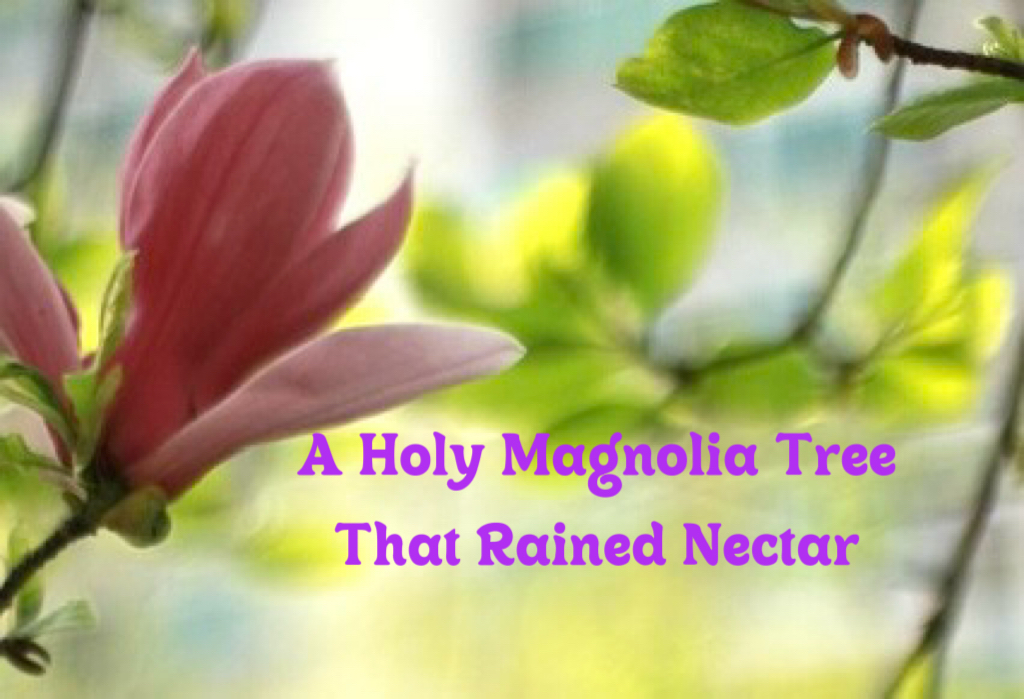
The holy magnolia tree rained nectar for three consecutive days. The nectar is a substance resulted from nothingness and descends from the sky. The event was not only witnessed by a lot of people, but also widely reported in the media and was known worldwide.
[ yi kui ren jia fu zhong yin yu shu chang kong lai gan lu zhao fan gan zhi mu bu lin ]
[ er zheng de xing chi jie guo yu chi zhan sheng deng hua zang jia shen nian kai si chun jiang jin ]
The first line of the couplet is “yi kui ren jia fu zhong yin yu shu chang kong lai gan lu zhao fan gan zhi mu bu lin.” Someone who calls himself a person of humility meditated under a magnolia tree and thereby planted holy seeds (causes). Suddenly, from the sky over the magnolia tree descended fragrant, sweet, and pure tasting nectar. That day, the blazing sun was shining down from the completely cloudless sky. There was not a drop of rain. Nectar descended like dense rain from morning until evening only in the area occupied by the magnolia tree’s approximately eleven-foot circumference. However, from morning until evening, not one drop of nectar wetted or moistened any of the branches of that tree. The ground under the tree was wet. People’s clothes were also wet. Yet, the tree branches remained dry.
The second line of the couplet is “er zheng de xing chi jie guo yu chi zhan sheng deng hua zang jia shen nian kai si chun jiang jin.” As a result of their practice, two self-cultivators attained a very high level of realization and virtue. They were able to lift a more than 4,000 pound lotus tub used to bathe the Buddha. Fourteen other people tried to lift that tub together but were unsuccessful. That lotus tub also manifested holy supernatural states. Thus, at the end of winter in the year called ’Jia Shen’ according to the Chinese calendar (i.e. 2004), that lotus tub used to bathe the Buddha was moved to Hua Zang Si and placed in the Pavilion Containing Evidence of Holy Events for worshipping. With the immanent arrival of spring, the causes and conditions to spread the dharma will mature. As spring begins, everything looks fresh again, and the opportunity to save living being sprouts.
Wangzha Shangzun, also known as Nick Best, lifted a 2,791-pound human carousel in the State of Georgia.
In the afternoon of March 6, 2019, peals of thunder could be heard rumbling above the sky of the Holy Miracles Temple, sounding like giant earthquakes and landslides. The rain came pouring down rapidly. The Grand Hall of Shakyamuni Buddha at the Holy Miracles Temple was crowded with nearly a thousand Buddhists from all over the world. Holding khatas with both hands, they kneeled to respectfully and sincerely welcome the greatly accomplished holy guru, Wangzha Shangzun.
Wangzha Shangzun is a great holy guru who has attained the level of Gold Button Grade 3. In this lifetime, He has followed H.H. Dorje Chang Buddha III to learn Buddha-Dharma and has attained tremendous accomplishment in holy realization. The Shangzun is considered the one and only Venerable King of Extraordinary Strength within the field of Buddhism throughout the entire world. He once conducted the Vajra Fa-man Holy Selection Grand Dharma Assembly during which He performed the Determination by Holy Selection in accordance with the Dharma and arrived at the determination that H.H. Dorje Chang Buddha III is the true incarnation of the primordial Buddha.
In 2016, Wangzha Shangzun personally presided over the holy exam held by the World Buddhism Association Headquarters for Dharma kings, rinpoches, Dharma masters, masters, and acaryas around the world. In establishing the Samsara Eight-Wind Array and Vajra Array, and with his holy realization, the Shangzun determined through Holy Selection the grade levels—the levels of accomplishment—of nearly 10,000 Buddhists. That astounded the world!
The Shangzun is, however, indifferent towards fame and fortune. In the past few years, He devoted himself to Dharma affairs of saving living beings. He rarely sees regular Buddhists except for seeing a very small number of high-level Buddhists. With the near-completion of the Dipankara Buddha Hall in the Holy Miracles Temple, and upon repeated requests by the monastics of the temple, the Shangzun has finally agreed to go to the Dipankara Buddha Hall periodically to chant sutras and mantras, to perform Dharmas, to pray for and bless faithful Buddhists who light lamps to beseech blessings. It was only under this karmic condition that the Shangzun agreed to publicly meet with Buddhists regardless of their level of accomplishment.
In the evening of March 6, Wangzha Shangzun arrived at Holy Miracles Temple. He walked with firm and stately pace as if a Vajra deity was descending to a mandala. A huge Vajra scepter which weighs about 1,000 jin (approximately 1,100 pounds) was placed in front of the entrance of the Grand Hall of Shakyamuni Buddha. According to the ancient Dharma rules in the time of Guru Padmasambhava, any great holy guru who attained the level of Gold Button Grade 3 must lift the temple-barrier Vajra scepter—the weight of which corresponds with the body weight and age of the holy guru—before they can stride over the scepter and enter the Buddha Hall. This Dharma rule is meant to verify if the Shangzun’s physical condition is healthy and if He has attained the standard of having transcended the ordinary. The rule requires Wangzha Shangzun to lift a 1,000 jin temple-barrier Vajra scepter before He can enter the Grand Hall to pay homage to H.H. Dorje Chang Buddha III.
Wangzha Shangzun has a Vajra-like physique that is tall and grand, and an appearance that is very dignified. He went up to the temple-barrier Vajra scepter, bent over, and lifted up the 1,000 jin Vajra scepter effortlessly, manifesting the mighty character of a Vajra deity. When He put the Vajra scepter back on the floor, the ground and the hall instantly shook and the congregation was astounded. Subsequently, Shangzun gracefully strode over the Vajra scepter and entered the Grand Hall. He prostrated to His Holiness Dorje Chang Buddha III as he spoke these words with utter sincerity, “I, disciple Wangzha, prostrate myself before the great Namo Dorje Chang Buddha III!” With his back bent and head bowed, He slowly came in front of His Holiness the Buddha. His Holiness the Buddha placed His hand on the Shangzun’s head. Afterwards, the Shangzun retreated to the side and ascended to His seat. He addressed the congregation, “Buddhist disciples, I’m very happy to see you here today. I’m happy because you have the karmic affinity in this lifetime to meet Namo Dorje Chang Buddha III. Thus, you’ll be able to learn the authentic Buddha Dharma, the unaltered and pristine Dharma. Because of this, you will be able to attain accomplishment within this lifetime. So of course, I’m very happy.”
Wangzha Shangzun blessed everyone in the congregation by placing His hand on each of their heads before He left. This went on until very late at night.
After the Shangzun left, Buddhist disciples were unable to hold back their curiosity about the 1,000 jin Vajra scepter. Many came forward to try lifting it. A body-builder and weight-lifter also gave it a try. Certainly, it is obvious that no matter how much strength they exerted, they were unable to lift it, and everyone shook their head when they resume standing. They were not even able to move it, not to say lift it. Two people tried to jointly lift one end, but the Vajra scepter did not move a bit. No wonder Shangzun is called the Venerable King of Extraordinary Strength.
Kankun Rinpoche, the attendant of Wangzha Shangzun, said, “On this planet earth, among all Dharma kings and rinpoches, you cannot find anyone who can lift the temple-barrier Vajra scepter. There are no temple-barrier Vajra scepters in front of their Grand Buddha Halls because this is a sharp weapon that exposes the nature of ordinary people. If they are not truly great holy people, do they dare to place a temple-barrier Vajra scepter in front of their Buddha Halls? Why? The reason is simple. True Buddha-Dharma has already become extinct. What people have learned are fragmented empty theories. No matter how reputable some of the Dharma kings or rinpoches are, or how high their status may be, their physical bodies are essentially sickly and weak. How can they have any holy qualities in their bodies? How could they have a Vajra body developed from true Buddha-Dharma? The only place to witness true realization power is right here where Namo Dorje Chang Buddha III is. Only Wangzha Shangzun, a close disciple of H.H. Dorje Chang Buddha III, has truly attained realization powers manifested from the authentic Dharma of the Tathagatas. I dare say some of those Tibetan Dharma Kings who brag about their lineages and talk empty theories are very pitiful. They do all sorts of useless things to fool amateurs. Even though they pose to look energetic when ascending to the Dharma dais, their bodies are weak and sickly. They are tormented by their illnesses yet they continue to make up empty lies, and even fabricate false Buddha-Dharma. Since cultivators do not look for facts and only listen to empty talk, it is not surprising that they are being swindled! This is precisely the Dharma-ending age that Shakyamuni Buddha talked about where the demons prevail, Buddha-Dharma declines, and practitioners are often harmed. To cover up the fact that they are by nature ordinary people, some Dharma kings or rinpoches might say, ‘Our lineage places no emphasis on that!’ I am saying you can only deceive idiots. Whether or not you place emphasis on that, if you claim that you are a holy person and you have transcended the ordinary to become holy, why doesn’t your body have the great strength of a holy person? The undeniable facts are that you have no physical strength and your physical body is weak and sickly. Isn’t that true? If you disagree, show everyone that you can pick up the temple-barrier Vajra scepter! Just as with the Five Vidyas. Many people pretend to have Five Vidyas, but ultimately, where are their Five Vidyas? Can they show their Vidyas one by one? What level of accomplishment do they have in their Vidyas? They have nothing! Shakyamuni Buddha stipulated that a Bodhisattva must have Five Vidyas, yet you are deficient in the Five Vidyas, and without any level of accomplishment. You are clearly not a great Bodhisattva. By claiming to be a Bodhisattva, you are going against the teachings of Shakyamuni Buddha. You are simply an ordinary person and not a Bodhisattva at all!”








 頂禮 H.H. 第三世多杰羌佛-- 正教