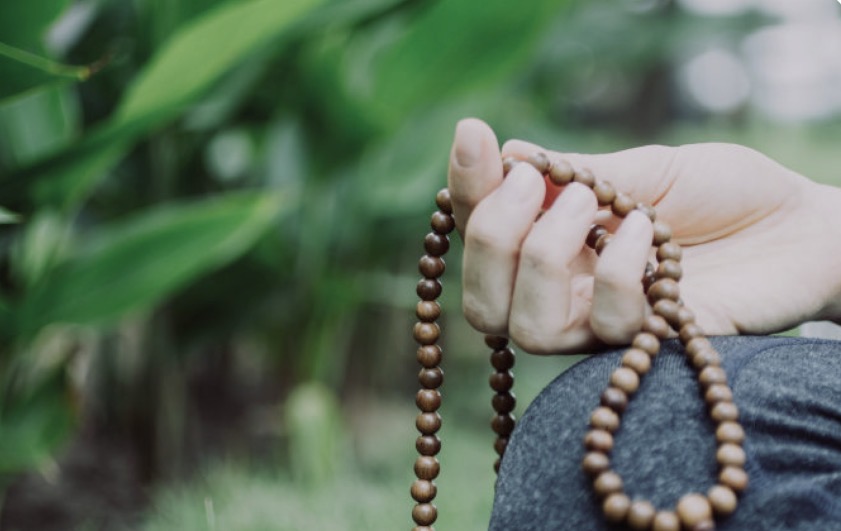
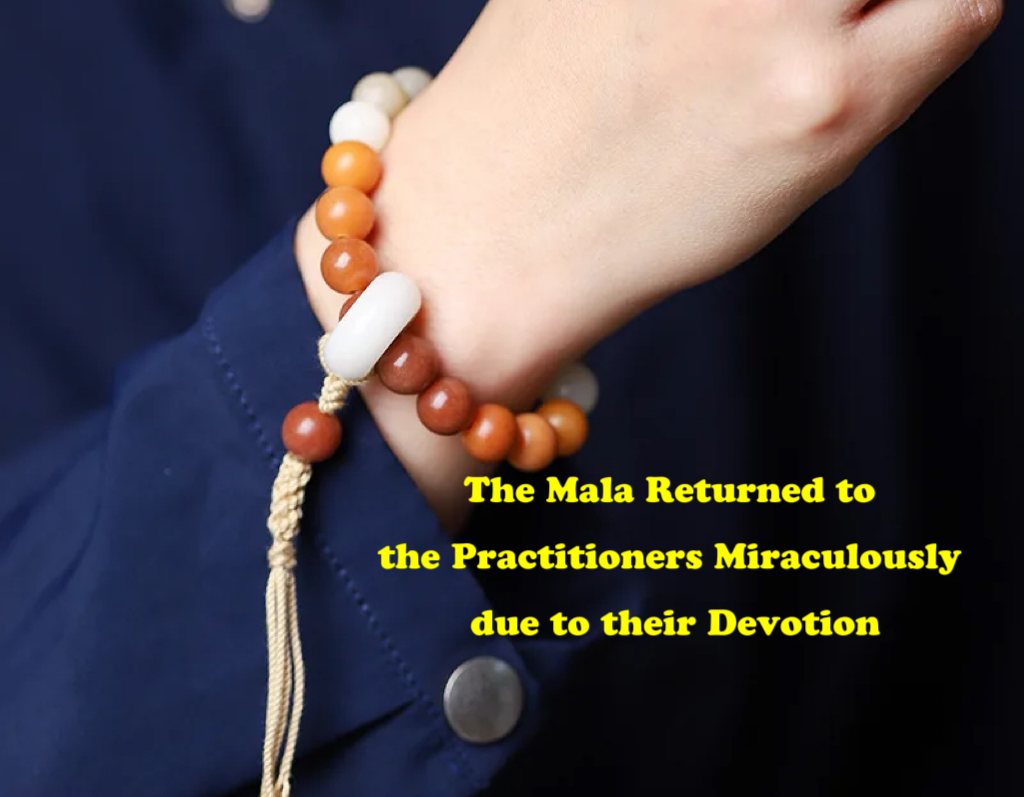
One night in August of 2008, my wife drove home and pulled over at the street outside of our house. She was on the phone with her sister in China. Because of the hot weather, she put away the mala on her wrist, placed it on the car seat, and opened the windows. The next day, after she woke up, she could not find her mala. She then recalled that she was on the phone with her sister in the car. She said to me, “I might have forgotten the mala in the car.” She hurried to the car to look for it. She went through the whole car and still could not find it. As she raised her head, she found out that the right rear window was open. She then realized that the situation had gotten serious. Somebody must have stolen the mala since she forgot to close the window.
This is a very beautiful Buddhist mala made of multi-colored stones. What makes it precious is that it has been empowered by H.H. Dorje Chang Buddha III. We regard it as priceless. After my wife got back, she was very frustrated. She sat on the chair and stayed silent for a long time. I kind of complained to her, “Look, how can you be so careless? You should not have misplaced it.” She remained silent. I did not say more, knowing that she was already very upset. I comforted her, “There is nothing else to do since it’s already lost. I’ll get another one for you.” Upon hearing this, she burst into tears. She mumbled, “This is a mala empowered by the Buddha. Where else can you find another one like this?” I was stunned by her outburst. I tried to calm her down and said,” Don’t cry. Don’t cry. I’ll get another one for you for now. Then, we’ll have to wait for another karmic condition for the blessing.”
Ever since, my wife always had regret. She often complained, “I’ve lost such a good mala!” Two months later, one day, my wife was about to fix a button. She took out the sewing box and yelled out, “Come look! Come look! My mala!” I ran over and saw the multi-colored stone mala in her hand. Her face was lit up with joy. She wondered, “That’s strange. How can my mala end up here? It’s impossible that I’ll ever put the mala in the sewing box! That’s odd, very odd!” She mumbled as she tried to figure it out, but, I know that deep inside her heart, she was very happy.
Then, it dawned on me that this is a true manifestation of the almighty power of the Buddha Dharma. I have read many testimonials of the manifestations of Buddha Dharma and holy feats. Yet, I have never encountered one personally. I thought it had to be the sincere devotion and repentance of my wife that invoked the compassion of the Buddhas and Bodhisattvas. The Dharma protectors had sent the priceless mala which had been empowered by the Buddha back to us. I immediately said to my wife, “Come on, let’s go and prostrate to thank the Buddhas and Bodhisattvas.”
From the incident, I deeply realized that Buddha Dharma is true and not false. It is limitless. As long as we have the pure and sincere heart for the Buddhas and Bodhisattvas, they will definitely empower us and make our wishes come true. My faith has also deepened. I am determined to cherish the rare and auspicious karmic condition in this life time. I will follow closely with H.H. Dorje Chang Buddha III, study hard and cultivate. I will persist on a practice in accordance with the teachings. I will fight to realize the ultimate Bodhi and attain liberation. With true realized virtue and power, I will take on the mission of the Tathagatha- the great Buddhist career of saving all beings.
I hereby swear that what I have just mentioned is true and not false. If ever I speak falsely and deceive the public, I will degenerate to the Vajra Hell. If my praises of the magnificent Buddha Dharma are true, I hope to dedicate the merits to my Buddha master and all sentient beings in the three spheres and the six realms. May the Dharma wheel of the Buddha turn forever.
May the Buddha Dharma shine universally to everyone in the world. May all sentient beings in the three spheres and six realms be given the opportunities to listen to the correct Dharma of Dorje Chang Buddha. May we all realize Bodhi together. Amitabha!
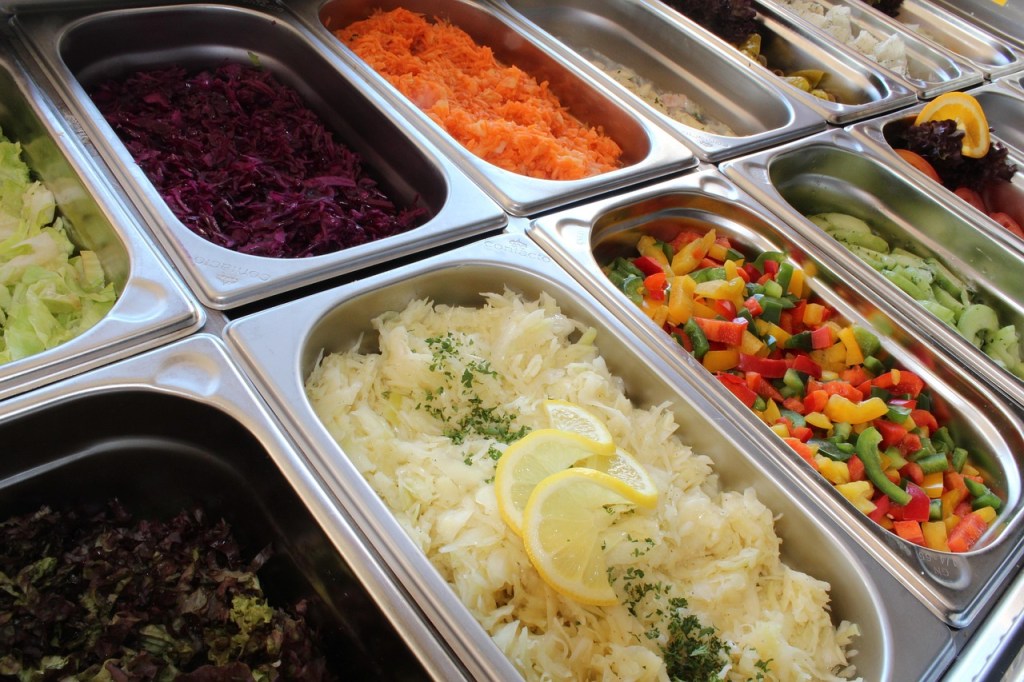
Hua Zang Si usually provides a vegetarian lunch to the attendees after the end of every Dharma assembly.
When I first tasted it, it dawned on me – How can there be such delicious vegetarian food in this world? It is tastier than any gourmet food I have ever eaten. It is comforting and stays in your heart.
The ingredients may be common vegetables, such as tofu, or mushrooms and even the rice is just simple white rice. It is not greasy and they do not always season the food with chilies for aroma. It reminds you of the most delicious dish that your Mom cooked when you were little.
I wonder if it is because I have grown tired of the same old greasy food or it is just an illusion I got from a new taste. However, this fine feeling has never changed for several years from the first time I went to Hua Zang Si until now. I also have heard similar praises from a number of other people. Eventually, I was convinced that the food provided by Hua Zang Si is good quality.
Later, I was fortunate enough to volunteer in the kitchen of Hua Zang Si – I saw how Buddhist brothers and sisters deliver fresh ingredients from a great distance on the day before the Dharma assembly. I have seen how many of Buddhist brothers, sisters, aunties, grandmas, and even some kids carefully clean and prepare potatoes, carrots, vegetables and fruits. I also noticed the hard work they do on the day of the Dharma assembly: They stir-fry the food, add water to control the heat, all under high temperature. I also noticed how they carefully store the prepared dishes in the warmers to keep the food warm. At the lunch time, I also have seen how the young volunteers attentively and efficiently spoon every side dish on the plates while wearing masks and gloves in spite of the heat. In addition, I have seen how the volunteers separate the used utensils and plates for recycle with a great deal of effort.
I have finally realized what is behind the delicious vegetarian lunch – it is self-cultivation at all times and all places.
In 2014, I was diagnosed with stage 2 spleen cancer and had the surgery performed at the University of Taiwan Hospital. In June the same year, I started chemotherapy. Sister Qinyi Zhou came to visit me in September that year and brought me a copy of the book The Buddha Speaks on Curing the Hemorrhoids Sutra. I chanted the sutra continuously for one month and I noticed the dark brown nails on my hands – the side effect of chemotherapy – had started to fade. It was unbelievable!
During that time, sister Zhou and Buddhist brother Sangdun Chuba Rinpoche frequently visited me and even helped me to begin to set up an altar and purchased all the necessary items to offer to the Buddhas. I also invited Buddhist brother Jijia Cuoren Rinpoche and many other Buddhist brothers and sisters to come to my house for the purification ceremony and beseeching blessings. I then set up my dharma-listening center. I requested recorded Dharma from International Buddhism Sangha Association in order to promote Buddha Dharma and benefit others. After that, miraculously my symptoms of peeling skins on my hands and feet and the mouth ulcer that was seriously affecting my eating gradually disappeared. What was even harder to believe was that the MRI done in November 2014 showed that the cancer had vanished. Cancer marker went from 67 to 46 in about a little more than 2 months – The terrifying spleen cancer just disappeared! I had never thought that chanting Buddhist Sutras and setting up a Dharma-listening center would have such powerful blessing on me!
Seeing my progress, sister Zhou encouraged me to take the examination to become a Master of Dharma-Listening Sessions so that I could promote the correct views and understanding of the Buddha dharma of H.H. Dorje Chang Buddha III to others. It would be the best way to benefit others and carry out the Bodhicitta. In so doing, I would receive even more blessings, she said. I did not disappoint her and successfully passed the exam in March 2015.
A few months after that, the doctor who was in charge of my chemotherapy, Dr. Yang, suddenly announced that my treatment should be stopped ahead of schedule ( normally it has to last for more than a year) This had never happened before! So, my confidence increased and I was even more diligent in listening to the Buddha Dharma and reading Buddhist books. I consistently rain or shine went to the group cultivation sessions held at Holy Dharma Compassion and Kindness Association. I cultivate myself and learn from the Buddha with a heart of repentance and gratitude. On September 21, 2016 my primary doctor, Professor Tian told me “no more doctor’s visits, just periodical rechecks in charged by Dr. Yang.” So I only need another doctor’s visit! What a great relief! I felt like a burden of rock has shifted off my shoulders.
During the past two years, if it was not because of the blessings of H.H. Dorje Chang Buddha III, if I did not study Buddhism and cultivate myself, if there was no help and encouragement from the Buddhist brothers and sisters , I would not have recovered from cancer and I would not have been able to travel around the world and gone to social functions! In contrast, my husband who had brain cancer and was very stubborn and did not want to believe in Buddhism died in May 2015.
I transform my grief to power and strongly believe in the law of cause and effect. I will continue to study Buddhism, listen to the recorded Dharma of H.H. Dorje Chang Buddha III, cultivate my words, thoughts, and behaviors, promote kindness and eradicate evil, and strive to correspond with the Buddha! Here, I would like to thank all the members of the medical team at Taiwan University who have treated me, all my relatives and family members, my Buddhist brothers and sisters for their kindness and care. They have made it possible for me to cultivate and learn from the Buddha! Amitabha!