Hua Zang Si usually provides a vegetarian lunch to the attendees after the end of every Dharma assembly.
When I first tasted it, it dawned on me – How can there be such delicious vegetarian food in this world? It is tastier than any gourmet food I have ever eaten. It is comforting and stays in your heart.
The ingredients may be common vegetables, such as tofu, or mushrooms and even the rice is just simple white rice. It is not greasy and they do not always season the food with chilies for aroma. It reminds you of the most delicious dish that your Mom cooked when you were little.
I wonder if it is because I have grown tired of the same old greasy food or it is just an illusion I got from a new taste. However, this fine feeling has never changed for several years from the first time I went to Hua Zang Si until now. I also have heard similar praises from a number of other people. Eventually, I was convinced that the food provided by Hua Zang Si is good quality.
Later, I was fortunate enough to volunteer in the kitchen of Hua Zang Si – I saw how Buddhist brothers and sisters deliver fresh ingredients from a great distance on the day before the Dharma assembly. I have seen how many of Buddhist brothers, sisters, aunties, grandmas, and even some kids carefully clean and prepare potatoes, carrots, vegetables and fruits. I also noticed the hard work they do on the day of the Dharma assembly: They stir-fry the food, add water to control the heat, all under high temperature. I also noticed how they carefully store the prepared dishes in the warmers to keep the food warm. At the lunch time, I also have seen how the young volunteers attentively and efficiently spoon every side dish on the plates while wearing masks and gloves in spite of the heat. In addition, I have seen how the volunteers separate the used utensils and plates for recycle with a great deal of effort.
I have finally realized what is behind the delicious vegetarian lunch – it is self-cultivation at all times and all places.
In 2014, I was diagnosed with stage 2 spleen cancer and had the surgery performed at the University of Taiwan Hospital. In June the same year, I started chemotherapy. Sister Qinyi Zhou came to visit me in September that year and brought me a copy of the book The Buddha Speaks on Curing the Hemorrhoids Sutra. I chanted the sutra continuously for one month and I noticed the dark brown nails on my hands – the side effect of chemotherapy – had started to fade. It was unbelievable!
During that time, sister Zhou and Buddhist brother Sangdun Chuba Rinpoche frequently visited me and even helped me to begin to set up an altar and purchased all the necessary items to offer to the Buddhas. I also invited Buddhist brother Jijia Cuoren Rinpoche and many other Buddhist brothers and sisters to come to my house for the purification ceremony and beseeching blessings. I then set up my dharma-listening center. I requested recorded Dharma from International Buddhism Sangha Association in order to promote Buddha Dharma and benefit others. After that, miraculously my symptoms of peeling skins on my hands and feet and the mouth ulcer that was seriously affecting my eating gradually disappeared. What was even harder to believe was that the MRI done in November 2014 showed that the cancer had vanished. Cancer marker went from 67 to 46 in about a little more than 2 months – The terrifying spleen cancer just disappeared! I had never thought that chanting Buddhist Sutras and setting up a Dharma-listening center would have such powerful blessing on me!
Seeing my progress, sister Zhou encouraged me to take the examination to become a Master of Dharma-Listening Sessions so that I could promote the correct views and understanding of the Buddha dharma of H.H. Dorje Chang Buddha III to others. It would be the best way to benefit others and carry out the Bodhicitta. In so doing, I would receive even more blessings, she said. I did not disappoint her and successfully passed the exam in March 2015.
A few months after that, the doctor who was in charge of my chemotherapy, Dr. Yang, suddenly announced that my treatment should be stopped ahead of schedule ( normally it has to last for more than a year) This had never happened before! So, my confidence increased and I was even more diligent in listening to the Buddha Dharma and reading Buddhist books. I consistently rain or shine went to the group cultivation sessions held at Holy Dharma Compassion and Kindness Association. I cultivate myself and learn from the Buddha with a heart of repentance and gratitude. On September 21, 2016 my primary doctor, Professor Tian told me “no more doctor’s visits, just periodical rechecks in charged by Dr. Yang.” So I only need another doctor’s visit! What a great relief! I felt like a burden of rock has shifted off my shoulders.
During the past two years, if it was not because of the blessings of H.H. Dorje Chang Buddha III, if I did not study Buddhism and cultivate myself, if there was no help and encouragement from the Buddhist brothers and sisters , I would not have recovered from cancer and I would not have been able to travel around the world and gone to social functions! In contrast, my husband who had brain cancer and was very stubborn and did not want to believe in Buddhism died in May 2015.
I transform my grief to power and strongly believe in the law of cause and effect. I will continue to study Buddhism, listen to the recorded Dharma of H.H. Dorje Chang Buddha III, cultivate my words, thoughts, and behaviors, promote kindness and eradicate evil, and strive to correspond with the Buddha! Here, I would like to thank all the members of the medical team at Taiwan University who have treated me, all my relatives and family members, my Buddhist brothers and sisters for their kindness and care. They have made it possible for me to cultivate and learn from the Buddha! Amitabha!
Writing articles has never being an easy task for me. The challenge only compounded when it comes to speaking from the heart. Also, the impact the Buddha dharma has had on my life is profound. This is especially true since I embarked on the journey of learning Buddhism.
I have the great fortune to have the opportunity to respectfully listen to the Dharma Discourses expounded by H.H.Dorje Chang Buddha III on a frequent basis. The Buddha repeatedly reminds me that a Buddhist cultivator must resolutely and clearly believe in the laws of cause and effect. Additionally, we must be mindful of constantly improving our speech, thoughts and actions. I planted these teachings deep in my heart.
In daily life, I am constantly mindful of my speech, thoughts and action during social interactions and how I manage affairs. And often contemplate and rectify my short comings. As a result, I become less agitated and my worries and troubling thoughts have reduced. Things that used to mire me in worry and despair, I can now wave them away with a chuckle.
Individuals, who used to cause me unpleasantness, no longer impose such an unwelcome impression. Just when I commended myself about the improvement, something happened that almost obliterated my calm and peaceful state of mind.
A Sudden Trial and a Precarious Situation
About half a year ago, when a good friend of mine ran into difficulties, I did all I could to help him as a friend. However, things sometimes have minds of their own. Not only were the results not as expected, but it roused dissatisfaction and misunderstanding from my friend. He twisted my pure intention and accused me of purposeful deceit. Furthermore, he even threatened me with legal recourse.
Other friends were well aware of my honest intention and supported me with their heart, but they could not tangibly help me in any way. I found myself between a rock and a hard place. I have never found myself in such a precarious situation. I can honestly say I did nothing wrong, but things were careening down a narrow one-way street with no room for maneuvering. I did not know how to face the situation calm and collected.
Seeking Blessings at Hua Zang Si
In deep despair facing this seemingly helpless troubling situation, the only thing that I could do was to go to Hua Zang Si and confess to the Buddhas and Bodhisattvas everything and to beseech blessing.
Walking in Hua Zang Si that day, I felt depressed and helpless beyond words. I even felt that I could not breathe. After I paid my homage, I joined my palms and knelt down in front of Buddhas and Bodhisattvas and started to report the entire situation.
Experiencing the Empowerment of the Buddhas and Bodhisattvas
Then what happened next was something that I shall remember for the rest of my life. After only three to four sentences, my complex despondence suddenly lifted and my heart became unbelievably calm. It was as if an ominous grey sky suddenly transformed into a vast limitless blue sky. This very situation, regarded as even more serious as “the sky is falling” just a few seconds ago, suddenly no longer had any effect on me. I felt an indescribable calm and peace that I have never experienced before. It was as if I had been transported to Shari-la, and I felt complete ease and tranquility.
I immediately registered this sudden change of my state of mind. Tears rushed down my face before I even knew it. I finally felt the empowerment of the Buddhas and Bodhisattvas, something I have yearned for a very long time. From that day forward, nothing fazed me again. I could completely let go of anything. A while later the situation with my friend ran its course and resolved in a positive manner. Once again, I want to express sincere gratitude to the Buddhas and Bodhisattvas.
Letting Go with Gratitude
As a consequence of this experience, now whatever is thrown my way, I may feel misunderstood or sad, but I never have even a slight hint of hatred. I could forbear and never put blame on anyone. Reflecting upon it, I am grateful for such an opportunity. This is because ever since this situation I am able to face anything in my life constructively with rectitude.
This self-transformation could only become possible when I began to learn Buddhism. I understand the laws of cause and effect never errs. Everything that we experience in this life is simply what we have done in the past coming to roost. Whatever happens, do not let it affect us. Definitely there is no need to complain about it. Instead, do our best to pay back the debt and dissolve all the negative karmic causes that we have planted since time immemorial.
Persisting on the Path Toward Enlightenment
From this moment forward, we should faithfully follow the teachings of Buddhas and Bodhisattvas. We should abide by precepts without deviation, and correct any imperfection of our speech, thoughts and actions little by little but persistently. As long as we stay on this course persistently, it is unequivocal that Buddhas and Bodhisattvas will confer empowerment upon us. In fact, such empowerment is without bound.
I just want to share this very experience with my fellow cultivators and let it serve as a mutual encouragement. The path of learning Buddhism is long and arduous. We will face challenges and calamities. But as long as our goal is clear and correct and we are resolved to reach that goal, as long as we can persist and forebear insult, we will be able to pacify all difficulties and obstacles. We will be on our way to the brilliant path of enlightenment.
From the bottom of my heart I wish all the cultivators be persistent. Plant good karmic causes and elevate ourselves to a higher level in our pursuit of learning Buddhism. May all of us realize Bodhi. Amitabha!
Hua Zang Si Holy Dharma Guang Wen Dharma-Listening Center
My first refuge taking ceremony took place at Hongfa Temple in Shenzhen on the 8th day of the 4th month of the Lunar Calendar in 2000 A.D. My dharma master was Great Monk Ben Huan. A few months later, following the recommendation of a fellow sister, I took refuge with H.E. Dulmo Choje Rinpoche who recently arrived from Qinghai. H. E. Dulmo Choje Rinpoche was praised as an accomplished cultivator. In May of 2002 at a friend’s house I met Baer Qing Rinpoche and took refuge once again with him. At that time I believed the more masters I had, the more Buddha dharma I could learn as well as to receive more empowerment. However, Master soon left. His only instruction was to recite the Four Limitless States of Mind and the Hundred Syllable Mantra.
In June of 2002, upon learning that Lhabum Rinpoche planned on staying in Shenzhen for an extended period of time, I took refuge with Lhabum Rinpoche. I reasoned that if I had a master whom I could visit frequently; my good fortune would surely increase. Indeed, I did attend many dharma assemblies, captive animal release rituals and the Eight Precept Retreat conducted by Lhabum Rinpoche. In addition, I did morning and evening chants at home. Sometimes I even practiced the Eight Precept Retreat on my own at home. Although I was busy every day, I only felt joy and never relented. At that time, I single mindedly wished only for good fortune and good luck. My only wish was that my master could transform my ill fortune into prosperity. To achieve this, I took additional refuges with Mozha Dharma King of Kathog Monastery and Wengzha Rinpoche from Tibet the following year.
Three years later, a friend asked me, “Why is it that you have been so devout, yet your life is still full of difficulties? “ I was saddened by this remark. Why is it that my study of Buddhism did not derive any actual benefit? Where did I go wrong? I really couldn’t figure out and felt mentally exhausted and depleted. No longer did I want to visit any master, rinpoche or master. I thought I could just study on my own. But, how? I often asked myself what the correct path was. How could I practice to obtain real result? In reality, I simply couldn’t find the answer.
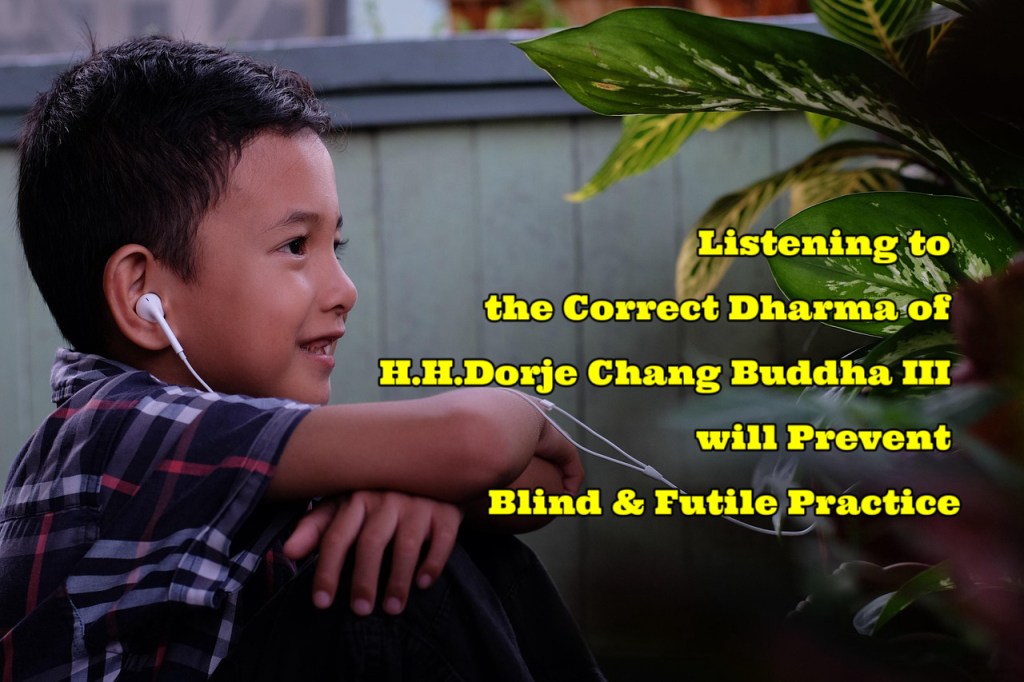
In March of 2009, my migraine resurfaced. While I was resting at home, fellow sister Zhou called me and invited me to her house to listen to the Dharma. I turned down her invitation stating I just wanted to rest peacefully at home because of the migraine. She said, “Come, this is the authentic Buddha dharma that is difficult to encounter in thousands of eons. You must come. Come and you will understand. I will be waiting for you.” So many people have invited me to meet masters and rinpoches. They were all supposedly to be great cultivators and rare to come upon. But, in the end, there was nothing special about all of them. My minds seethed with conflicting emotions. Finally, I told myself that if what I was about to see or hear was auspicious, it would reduce or completely eliminate my migraine. However, if what I was about to encounter made me feel uncomfortable or induce my migraine intolerable, I would just leave. After making my final decision, I hurriedly left for sister Zhou’s house. When I arrived, they had just started watching “Buddha-Bestowed nectar”. It was truly miraculous and unbelievable! It was a manifestation of authentic dharma power that I have never seen before. I completely forgot about my headache that whole day. The next day, I couldn’t wait to return to sister Zhou‘s house to listen to the Dharma. Its title was “Unparalleled Auspicious Buddha Dharma”. Tears streamed down my face as I listened. The Dharma was describing Buddhist disciples just like me. I was finally awakened by the Dharma realizing the mistakes of my past years. How could I regard myself studying Buddhism and cultivating myself? I spent all my past years studying blindly and futilely. Selfishly, I had only hoped for my own personal good fortune. I took refuge with every rinpoche and dharma king whom I have met. I did not understand the purpose of studying Buddhism and cultivation. I did not really cultivate myself or put my study into practice. That was why I had never achieved any substantial result.
Through listening to the Dharma, I developed correct views and understanding. I understood the reasons for studying Buddhism and self-cultivation. I developed a mindset to leave the world of impermanence, and to achieve liberation and realization. In addition, I vowed to obtain enlightenment and help others to do the same and to bravely carry on the mission of the Tathagata. From that day forward, I have devoted myself wholeheartedly into Dharma listening. On August 1, 2009, I took and passed the test to become a Master of Dharma-Listening Sessions. I am determined to introduce authentic Buddha dharma to everyone and anyone whom I have karma affinity with.
I have once been unemployed for many years and struggled economically. After listening to the Dharma for a period of time, one day, a friend of mine recommended me to an interview at a company. I was hired as section director. Even more amazingly I was promoted to the position of manager the next day! During the three months period from October of 2009 to December of 2009, both my personal as well as my group performances were ranked number one.
My American visa was approved in early June of 2010. Everything became very smooth. I believe all these events are attributed to the merits accumulated from listening to the Dharma and practicing according to the Dharma. It has increased my good karma and transformed the karmic consequences. In the past two years in America, I have persistently listened to the dharma. In addition, I organized dharma-listening sessions for those whom I have karma affinity with. I have obtained profound benefit from the Dharma expounded by H.H. Dorje Chang Buddha III. To me, it is a strong karmic condition to be able to be born in the same life time as the Buddha is present with us. Moreover, I can listen to the Dharma expounded by H.H. Dorje Chang Buddha III with my own ears which is indeed difficult to encounter in hundreds and thousands of eons. It is an absolutely auspicious and rare opportunity.
I often wonder if we cannot achieve enlightenment when a Buddha is here, still cannot break free from the chains of cause and effect and still trapped in the cycle of birth and death for hundreds of thousands of years reaping the karmic results of our past doing until we have the opportunity to be reborn as human beings, will we still have the opportunity to meet up with H.H. Dorje Chang Buddha III again? Will we still have the opportunity to listen to the Buddha’s Dharma? Where can we seek the path which will lead to liberation? The more I contemplate on it, the more frightened I become. I was horrified by the thought: If I cannot obtain enlightenment this life time, which other life time will it be?
Often I beseech the Buddhas and Bodhisattvas to empower me to plant the seeds of positive karmic affinity with living beings, to have the ability and wisdom to be of assistance to those whom I have karmic affinity with to study Buddha dharma, to listen and understand the Dharma expounded by H.H. Dorje Chang Buddha III, and to put the teachings of the Dharma into action. Resolutely and diligently we should study Buddhism and really cultivate ourselves so that we can achieve enlightenment before long! Amitabha!